A Ranger writes: the weird and wonderful world of lichens
Our Countryside Rangers have a wealth of knowledge on the places, plants and species that call East Lothian home. Ranger Richard English offers an insight into the weird and wonderful world of lichens.
As I’ve written in the past, fungi are strange - neither plant nor animal, but their own separate biological kingdom. However, if you want really weird then look no further than lichens. They’ll grow on trees, soil, gravestones, seashore rocks and pretty much everywhere else. The thing that makes lichens so odd, and so brilliant, is that they are not just one simple organism. Instead, they are two very different species living together for their mutual benefit (a relationship known as symbiosis).
Within any lichen the main “partner” is a species of fungus, known as a mycobiont. The other partner, the photobiont, is a green alga, or less commonly a species of cyanobacteria (also known as blue-green algae, although they’re not actually algae at all). Occasionally, a lichen containing a fungus and an alga will also have cyanobacteria kicking around in there, thus having all three of the potential partners.
So, why do these various organisms bother to get together like this? Well, each brings something different to the party. The fungus can derive mineral nutrients from the surrounding environment and provides a sheltered habitat for the alga. In turn, the alga can produce chemical food for the whole organism through photosynthesis.
Lichens come in four main categories:
- crustose (crusty)
- squamulose (scaly)
- oliose (leafy)
- fruticose (branched or bushy)
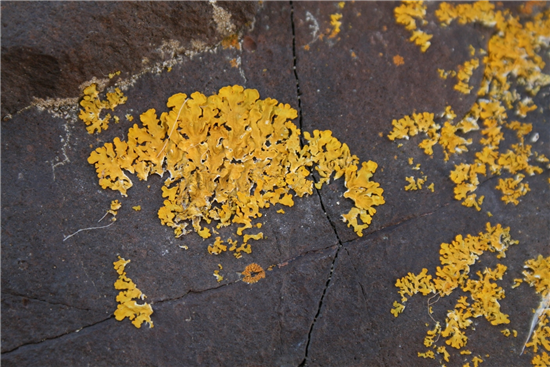 Xanthoria
Xanthoria is a genus of foliose lichens which can be found growing on rocks and trees. Some species of Xanthoria favour seashore rocks, which has led to them being called “shore lichens”. They take the form of bright yellow splodges, sometimes with orangey cup-like structures dotted throughout. These cups generate the spores by which the lichens reproduce. This lichen’s name is derived from xanthos, the Greek for “yellow”. On a cold, grey January’s day the appearance of Xanthoria can definitely brighten things up.
A much less obvious, but equally fascinating lichen genus is Ramalina. These are fruticose lichens, taking the form of grey-green flattened branches usually growing on rocks. They can take the appearance of rather dodgy-looking pasta. Some species are particularly fond of coastal rocks on which seabirds perch. The birds, or rather their guano, produce a high level of nutrients on the rock surface and the lichen’s fungal element can exploit this to the full.
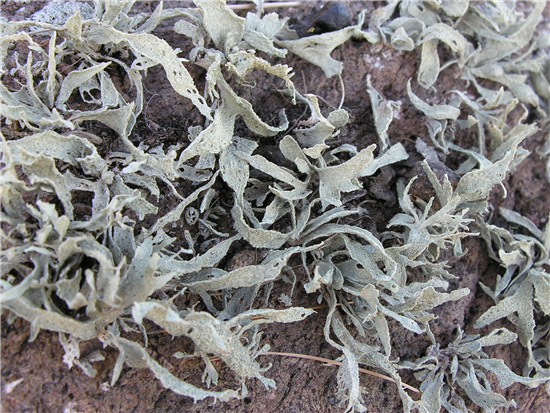 Ramalina Polymorpha
Lichens may not be the most obvious or glamorous of organisms, they may also be very difficult to identify. However, they form a vital part of a healthy environment. Lichens are used for food and shelter by a range of insects and other invertebrates. In some cases they are also eaten by much larger animals, including reindeer. Small birds such as long-tailed tits and goldcrests use lichens as camouflage or decoration when building their nests. Perhaps their most important use (for us at least) is as indicators of air quality - many species are very intolerant of pollution and so will only flourish in areas with clean air.
Keep up to date
Keep up to date with all things Countryside Ranger on the service’s Facebook or Instagram pages. You’ll find news and information to help you make the most of your time in our coast and countryside spaces as well as beautiful photography of the species that live here.
Facebook: @ELCrangers
Instagram: @elcrangers