A Ranger writes - the colourful, but toxic cinnabar moth
Survival is a big deal for animals, if you don’t mind me stating the obvious. Threats come in various forms – not least the presence of predators. So how best to avoid things that might see you as lunch? Some species will take the approach of using camouflage – if a predator can’t see you, it can’t eat you. Others might have some form of physical defence, such as a hard shell or exoskeleton.
One method adopted by several invertebrate species is to use their markings and colouration as deterrents against predation. Peacock butterflies feature large colourful circular patterns on their wings, which resemble eyes. These are thought to confuse and intimidate the butterfly’s predators, mostly small birds such as blue tits, allowing the peacock the chance to escape.
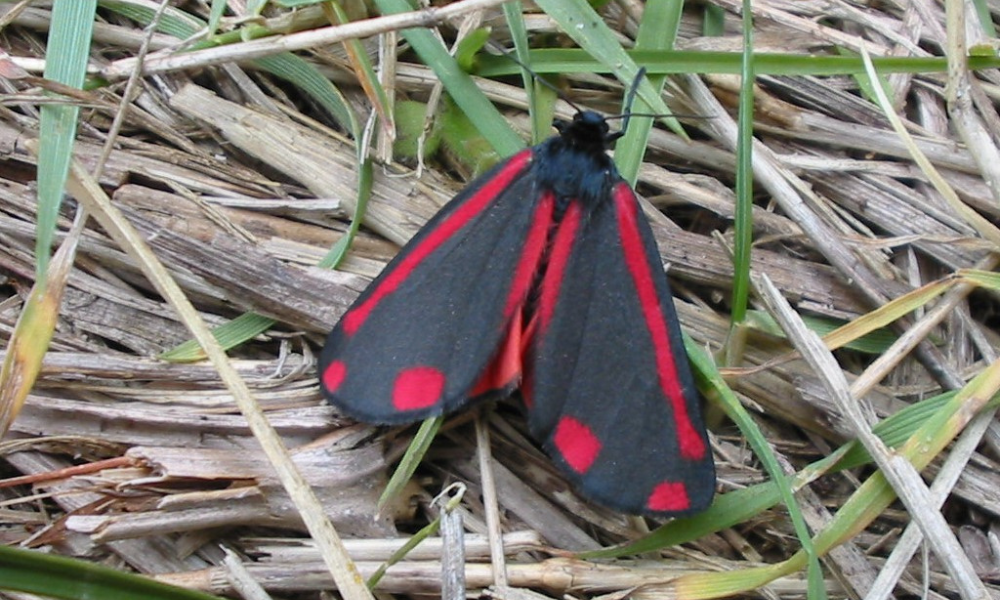
Some species have a seemingly counter-intuitive approach, adopting bright colours, often in a combination of yellow, red and black. Whilst this makes the individual fairly easy to spot, it acts as a warning to predators that it has some form of built in defence (think bees and wasps, equipped as they are with stings). The cinnabar moth also follows this type of colouration, but, in this case, it is to warn predators that the moth is toxic.
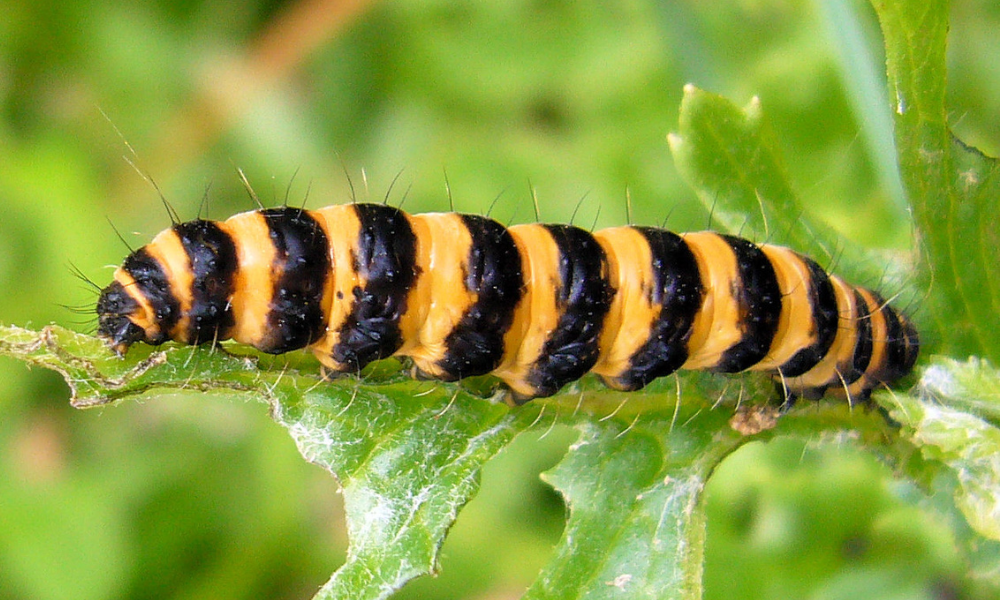
The cinnabar’s larval form is a bright yellow and black caterpillar, which can be seen in coastal grasslands throughout the county. It is almost always found on common ragwort plants, since this forms the main food plant of the caterpillar. Ragwort contains alkaloid toxins, which makes it dangerous to grazing animals, but has no detrimental effects on the caterpillars. On the contrary, they are able to absorb the toxins, thereby making themselves unpalatable and poisonous to most predators. The caterpillars are voracious eaters and can quickly strip ragwort plants of all their leaves. If their food becomes too scarce, things can get a bit gruesome – cinnabar caterpillars have been known to turn to a spot of light cannibalism to get by.
The adult moths fly by both day and night, which makes them a whole lot easy to see than many other moth species. In the adult colouration, the yellow of the caterpillar is replaced by red, but the warning remains the same, since the toxins persist into the adult stage. It’s a very good-looking moth, with mainly black forewings with striking red stripes and spots, whilst the hindwings are bright red with black borders. The stripes on the wings help to distinguish it from the burnet moths, which are also red and black and spotted.
The moth’s name is derived from the bright red mineral cinnabar, an ore of mercury, which, coincidentally, is itself highly poisonous. The species’ scientific name, Tyria jacobaeae, shows the moth’s close relationship with ragwort (Senecio jacobaeae). The close link between moth and plant can be problematic. The poisonous nature of ragwort means that it often requires control measures where livestock grazes. However, in the wider countryside, it poses no real danger and its value to the cinnabar moth and other insects makes it an important part of grassland habitats.