A Ranger writes: stars of the shore
Our Countryside Rangers have a wealth of knowledge on the places, plants and species that call East Lothian home. In this issue, Ranger Richard English dips his toes into a rockpool to tell us about starfish.
Summer’s nearly here and people will be heading for the seaside, often to look in rockpools to search for resident beasties. Rockpools can be tricky places to live in. Not only do plants and animals here have to deal with waves, tides, pollution, desiccation, salinity and small children, but they also have to avoid some fairly fearsome predators. The latter includes gulls and other birds, dog whelks and, occasionally, small children.
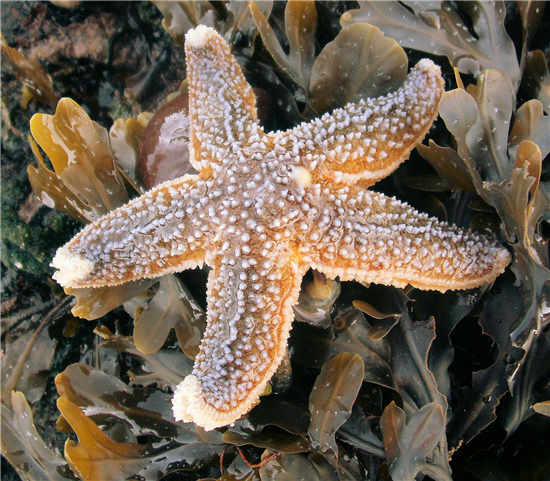 Common starfish
One predator that most will recognise is the Common starfish, with its familiar five arms and warty, orange-brown upper side. On the underside, things get very interesting. Along each of the arms are many small tube-feet which allow the starfish to attach itself to rocks and other surfaces. These help the animal to move around, but are also used in feeding. Sometimes the tube feet will simply pick up scavenged bits of food and pass it into the mouth, located in the middle of the central disc. However, the tube-feet can also be used to pick up larger prey and even to pry apart the two halves of mussel shells; and this is where things get really macabre. Once the shell is open, the starfish pushes part of its stomach out through its mouth and starts to digest the mussel. Once the prey is suitably liquefied, the stomach will be pulled back in, bringing the remains of the mussel along. Don’t try this at home.
Another starfish found on our coastline is the delightfully titled Bloody Henry – the name being derived from its vivid red-purple colour. There are actually two separate species of Bloody Henry, but they are difficult to tell apart even for the expert.
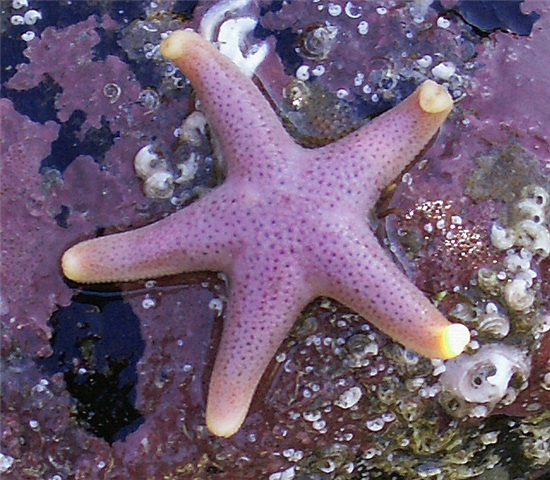 Bloody Henry starfish
This is a less predatory starfish which feeds mostly on plankton and other floating bits and pieces, although they have been known to prey on sponges. Females show a lot more maternal instinct than many invertebrates. They lay eggs wrapped in mucus on the sea bed and then actively guard them, rather than the usual approach of just letting them get on with things.
A close relative of the starfish are the brittle stars. A quick glimpse of one of these will demonstrate how they got the name. Their long, thin arms appear very fragile and will indeed begin to disintegrate with even delicate handling. This isn’t the disaster that it may seem, since both brittle stars and starfish are able to regrow lost limbs. Sometimes brittle stars will actively shed parts of their arms to avoid predators.
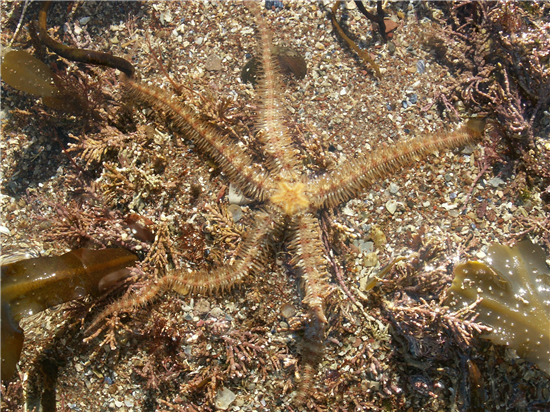 Brittle star
Brittle stars come in a variety of colours, ranging from dull browns to purples, reds and blues. They can occur in large numbers, sometimes forming “beds” of thousands on the sea floor. We’re far more likely to see them under rocks, but even here you can find several individuals together.
Rockpools are always worth checking out as they’re home to some weird and wonderful creatures -please treat them with the respect they deserve. If you’re looking under rocks, remember to replace them gently; you don’t want to squash any living thing underneath. Or your toes.
Keep up to date
Keep up to date with all things Countryside Ranger on the service’s Facebook or Instagram pages. You’ll find news and information to help you make the most of your time in our coast and countryside spaces as well as beautiful photography of the species that live here.
Facebook: @ELCrangers
Instagram: @elcrangers