Green Corner
Tree planting marks 50 years of John Muir Country Park
A commemorative tree planting took place at John Muir Country Park to celebrate the 50th anniversary of its founding.
The 1763-acre site, which lies near Dunbar and West Barns and stretches across eight miles of coastline, was designated as a Country Park in October 1976.
The park was named in honour of John Muir, the naturalist and conservation pioneer, who was born in Dunbar in 1838 before emigrating to the United States.
Managed by us under an agreement with the landowners, the park is famed for its rich biodiversity and sweeping landscape.
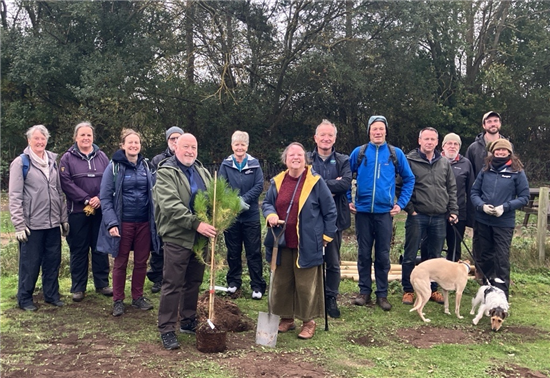
Countryside Rangers were joined by Councillor Colin McGinn and members of the John Muir Advisory Groups for last month’s commemoration event. Representatives from NatureScot, Wild About West Barns, Sustaining Dunbar, the East Lothian Antiquarian and Field Naturalists’ Society, the community councils of Dunbar, West Barns and Dunpender, and other volunteers helped plant three silver birches and two Monterey pines, a tree to represent each decade of the park’s history.
John Muir Country Park is also designated as a Site of Special Scientific Interest (SSSI), Special Protection Area (SPA) and a Ramsar site for its biological, geological and coastal significance.
It is renowned for its array of habitats which include saltmarshes, mudflats, sand dunes, woodlands, scrub, permanent grassland, and both rocky and sandy shorelines.
The park plays home to an abundance of bird life including greenshanks, whimbrels, little tern, kittiwakes, skylarks, lapwings, ringed plovers and gannets. In addition, a variety of insects and other wildlife are supported there while around 400 plant species have been recorded.
John Muir Country Park was registered by the Countryside Commission for Scotland as a Country Park on 12 October 1976 to afford the public’s “enjoyment of the countryside or open-air recreation” under the Countryside (Scotland) Act 1967.
Key location
The park is a key location along the John Muir Way, the long-distance walk between Dunbar and Helensburgh.
John Muir was a naturalist, environmental philosopher, botanist, zoologist and glaciologist who became one of the earliest and most influential advocates for wilderness conservation in the US. Before his death in 1914, his writings and campaigns helped shape the modern conservation movement and played a key part in the creation of several national parks, including Yosemite.
John Muir’s Birthplace museum on Dunbar’s High Street is hosting a new exhibition of photographs to celebrate the park’s anniversary along with reflections from staff, volunteers and Junior Rangers. The free exhibition, which will run until 10 January 2027, is open Wednesday to Saturday from 10am to 5pm and Sunday between 1pm and 5pm. Find out more about this and other museum events in this month's What's On.
Fully and part funded home energy improvements for homeowners now available in East Lothian
If you own a home in East Lothian, our Home Energy Team could help you make it warmer, greener and cheaper to run.
We have Scottish Government funding to offer fully and part funded home energy improvements for:
- solar panels and battery storage
- cavity and external wall insultation
- loft insulation
This financial year we are concentrating on homes in Tranent and Prestonpans but we are also happy to take enquiries from other areas.
We will help at every step, from advice on what will help your home to funding and arranging the work through one of our trusted contractors. Our straightforward approach makes the process easy while delivering high-quality workmanship and a warmer home.
You may qualify if you meet one or more of the criteria below:
- own your own home
- live in a Council Tax band A-C property
- have an EPC of D or below*
- spend more than 10% of your net income on fuel costs**
*If you don’t know what your Energy Performance Certificate rating is, we can find out for you.
**Net income is your monthly income minus childcare, energy and mortgage cost. If you’re unsure how to calculate this, we can help.
If you would like more information for yourself or any clients you work with through your council role, contact our Home Energy Team to check eligibility. The application deadline is 31 May 2027.
Email: energyteam@eastlothian.gov.uk
Phone: 01620 827325
Report highlights improvements to recycling services
A new report has highlighted improvements to our council's household recycling services in East Lothian in recent years and the resulting benefits.
The update report presented to Council detailed operational changes, performance successes and environmental initiatives delivered by Waste Services.
New figures showed East Lothian is a UK leader among local authorities in kerbside recycling with the collection system achieving contamination rates below five per cent.
 Councillor John McMillan recently visited our Kinwegar Recycling Centre and
met with Waste Services Officer Peter Moore and Recycling Adviser Helen Reilly.
Elected members heard service improvements helped the county attain the third highest recycling rate among Scotland’s 32 councils at 54.3 per cent.
The report also highlighted the contribution of residents who separate recyclable materials prior to collection, increasing their value within recycling markets as well as bolstering environmental sustainability. The disposal cost savings from good recycling practices by householders saved our council around £1.5 million in 2024.
Councillors were told recyclable materials are sold into national markets, generating around £250,000 in annual income to fund our much-needed services.
Since becoming a signatory to the Scottish Government Household Recycling Charter in 2016, our council has introduced significant changes to boost recycling and reduce waste sent for disposal. To comply with the Charter, weekly kerbside recycling collections were brought in for all households in 2021. In April 2024, three weekly residual waste collections were implemented, reducing weekly residual waste capacity from 120 litres to 80 and raising participation in recycling.
Successful recycling
Every domestic household receives 17 non-recyclable waste collections and 52 recycling collections each year, with around 24,000 households benefiting from 24 garden waste collections under the permit scheme introduced in 2024. This amounts to up to 93 collections per property annually, equating to almost 4.4 million individual collections.
In addition, the report outlined a range of our successful recycling programmes.
In 2024, 3296 tonnes of food waste was sent for treatment through anaerobic digestion, a process where organic material is broken down to produce both biogas, which is used to generate renewable energy, and digestate, a nutrient-rich by-product used as an agricultural soil conditioner.
Some 4371 tonnes of paper, card and cardboard were supplied for specialist reprocessing in the same year while 1951 tonnes of mixed cans and plastics were delivered to a Material Recovery Facility for sorting and separation.
Another 3157 tonnes of glass was supplied to a local reprocessor in 2024 where the glass was transformed into filtration media used in water treatment systems, including applications to provide access to clean and safe drinking water in developing countries.
Our recycling centres at Kinwegar, Dunbar and North Berwick record just over 500,000 visits each year while more than 9,000 bulky uplift collection appointments are offered to residents annually.
A Ranger Writes - tar spots and leaf life cycles
Countryside Ranger Richard English talks tar spots and sheds new light on the difference the environment makes to a leaf's life cycle.
If you’re out and about near sycamore trees, take a look at their leaves (which may involve looking at the ground, given the time of year). You’re likely to find that they are covered in black, or very dark brown, spots. These are caused by the tar spot fungus, Rhytisma acerinum. This is a very widespread species, found throughout the UK, Ireland, northern and central Europe and North America. It affects a range of trees belonging to the genus Acer – basically maples and their relatives. This broad distribution has led to the fungus having different names in different places. Here, you might hear it referred to as sycamore tar spot, whereas in America it’s more likely to be called tar spot of maples.
Complex life cycle
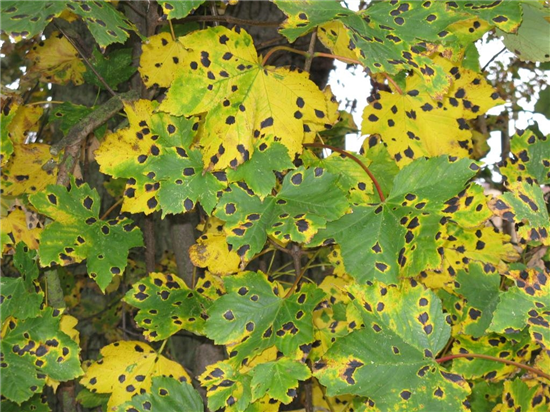 Tar spots on leaves. Photo credit M J Richardson
This fungus belongs to a group called the ascomycetes, which don’t produce the classic mushroom-type fruiting body. Instead, the spores are borne in tiny sac-like cells called asci. The tar spot has a very complex life-cycle, which is perfectly adapted to the changing seasons. The tar spot lesions start to form in spring, as spores from the previous year’s fungi colonise young sycamore leaves.
At first, these appear as pale green or yellow patches, which gradually spread. As the summer progresses, these develop into the characteristic black spots, although they often retain a yellow fringe. The darkening of the spots results from the development of fungal tissue known as mycelium, through which the fungus is able to absorb nutrients from the leaf.
During late summer, asexual spores are produced within the lesions, although the purpose of these spores in unclear, as they don’t seem to have any real function in the reproduction of the fungus. I’m sure that the fungus has very good reasons for doing this – we just haven’t sussed them out yet.
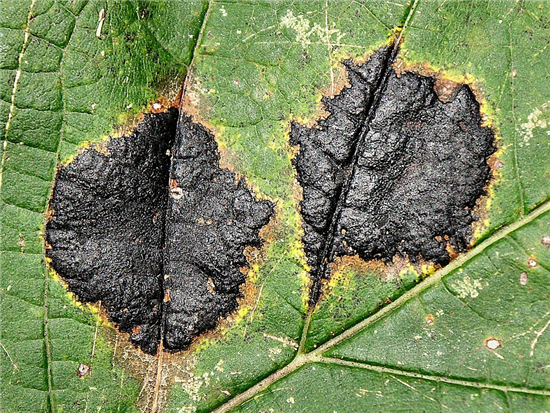 Tar spot up close. Photo credit Ian Alexander
An admission
However, it’s in the autumn and winter that the really cool stuff happens. Cup-shaped bodies, called apothecia, which contain the asci (remember them?) develop within the spots. These apothecia survive the winter on fallen leaves and it’s during this period that sexual spores develop within the asci. As things warm up in the spring, the spores are released, just when there are lots of lovely new sycamore leaves waiting for them.
Right, enough technical stuff and on to an admission. It used to be widely thought that tar spot fungus was indicative of good air quality. This was due to the fungus being rare on urban trees and also, in lab tests, being vulnerable to damage from certain pollutants common in towns, particularly sulphur dioxide. However, it now appears that the absence of tar spot in urban areas is likely due to road sweepers and diligent gardeners clearing away fallen leaves, thus interrupting the life-cycle.
I have to hold my hands up to having told people about the air quality thing in the past – I may have even written about it in these pages in previous articles. It just goes to show that even an old ranger can learn new things.
Keep up to date
Keep up to date with all things Countryside Ranger on the service’s Facebook or Instagram pages. You’ll find news and information to help you make the most of your time in our coast and countryside spaces as well as beautiful photography of the species that live here.
Facebook: @ELCrangers
Instagram: @elcrangers