If you go down to the woods today... A ranger writes
Our Countryside Rangers have a wealth of knowledge on the places, plants and species that call East Lothian home. In this issue, Ranger Richard English tells us about the fungi to look out for on your September walks.
September can be an odd kind of month – it’s not quite summer, not quite autumn. Some days will be lovely and warm, whilst others will have you reaching for your winter coat. Whatever the weather, September is a time when fungi will be appearing all over the countryside.
Fantastically diverse
Fungi come in a variety of shapes and sizes and have a fantastically diverse range of lifestyles. Some are parasitic, whilst many live on dead wood or leaf-litter and help to recycle nutrients from these back into the soil, providing a valuable service to plants. Some even enter into symbiotic (i.e. mutually beneficial) relationships with trees. In this case the fungus feeds on the products of the tree’s photosynthesis, whilst the plant gains chemicals such as nitrogen from the fungal action in the soil.
One of the more traditionally mushroom-shaped group of fungi are the russulas, or brittlegills. The caps of these fungi come in a variety of brilliant colours, including reds, yellows and purples. This often contrasts with the clear white of the gills (the grooved bits on the underside of the cap) and the stipe (or stalk). They generally grow in deciduous woodlands (where they indulge in that symbiosis mentioned earlier), although can be found in a variety of other habitats. Some are edible, whilst others are poisonous.
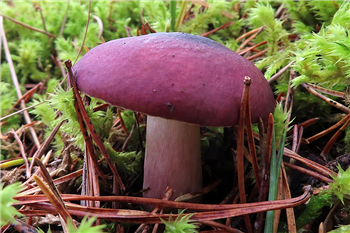 Russula: credit Anne Burgess (geograph.org.uk)
A slightly odder-looking bunch are the cup fungi. These belong to a group called the ascomycetes. They have a rather aggressive approach to releasing their spores, firing them from specially adapted cells, occasionally reaching distances of 30cm. The orange cup fungus takes the unsurprising form of a bright orange cup, up to 1.5 cm across. When young these are usually just concave discs, but as they age the cup becomes deeper and more irregular. They can be found alone, or in small groups, in soil in woodland clearings and other open areas.
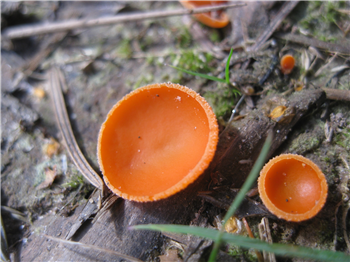 Orange cup fungus
The fly agaric (Amanita muscaria) is one of our most familiar mushrooms – it’s the classic red and white spotty one that garden gnomes often sit on while fishing. The white spots are actually the remains of a veil which completely covers the young mushroom as it emerges. This veil gradually breaks up and can eventually disappear altogether. This is why older fly agarics may be found with no spots at all.
From Shamans to Vikings...
This species forms a symbiotic relationship with birch or pine and is a common feature of the forests of northern Europe (including Scotland). It also has a long history in folklore. It was used by Siberian shamans to produce a trance state and was thought to account for the ferocity of Viking berserkers. It has also been used as a pesticide. The mushroom would be crumbled into milk and left out to attract flies, which would then be killed by the fungus’ toxins – also thought to be the derivation of the common name.
Whether they are quietly recycling nutrients beneath our feet, forming partnerships with trees or inspiring folklore, fungi are a fascinating feature of the autumn countryside.
Keep up to date
Keep up to date with all things Countryside Ranger on the service’s Facebook or Instagram pages. You’ll find news and information to help you make the most of your time in our coast and countryside spaces as well as beautiful photography of the species that live here.
Facebook: @ELCrangers
Instagram: @elcrangers