A Ranger Writes: look out for larch this Autumn
It's October and our countryside is changing with rich reds and bright yellow leaves reflecting Autumn sunshine. Countryside Ranger Ranger Richard English explains why larch is an outlier amongst coniferous trees and valued by garden designers, timber companies and wildlife alike.
Now that we’re heading well and truly into autumn, there will be very clear signs of change around the countryside. One of the most obvious and, frankly, cliched is the colouring up and eventual dropping of leaves from many of our trees. Trees respond to falling temperatures and shorter days by preparing to shut down for winter. As this happens, chlorophyll in the leaves (which produces the green colour) starts to break down, revealing other pigments such as carotenes and xanthophylls, which give the leaves their characteristic autumn orange and yellow colours.
Of course, not all trees do this – some retain their green leaves and their ability to photosynthesise all year round. In the UK, broad-leaved trees are generally deciduous, although holly is an obvious exception. While all three of our native conifers (Scots pine, yew and juniper) are evergreen, there’s one introduced coniferous genus that does the whole autumnal leaf-shedding thing.
European larch
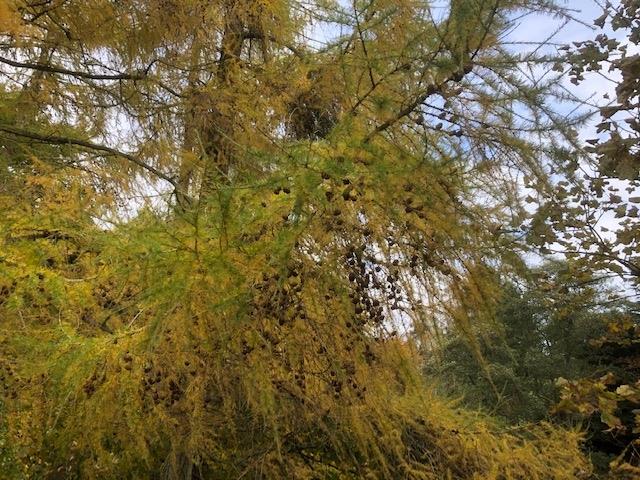 The European larch (Larix decidua) was brought to the UK in the 1620s. It was thought to have been introduced by the famous botanist/gardener/plant hunter John Tradescant. It was planted in a number of estates around the country, largely for its ornamental value – the autumn colour no doubt contributing to this. It has, along with its relative the Japanese larch (Larix kaempferi) with which it readily hybridises, become a valuable timber tree.
The hybrid is known as the Dunkeld larch, since it was there, on land belonging to the Dukes of Atholl, that it was first discovered. It is widely regarded as producing better timber than either of the parent species, since it is faster growing and has greater disease resistance.
So, larches should be easy to spot this month – they’ll be the only conifers shedding their non-green leaves. However, it’s definitely worth getting a closer look at some of the details.
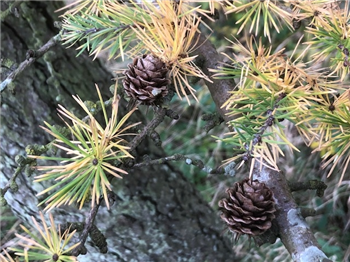
The leaves have the characteristic needle-like appearance common to conifers, but are finer than those of pines. They grow in clumps of up to forty emerging from woody spurs along the branches. These spurs remain once the leaves are shed, giving the winter twigs a distinctive knobbly look.
Rose-like appearance
The cones of the larch are small and woody. They tend to remain on the tree a lot longer than those of other species, which often fall off over winter. In the European larch the mature cones are compact, brown and roughly egg-shaped. In the Japanese larch they are a bit more open, with the tips of each scale curled back, giving them a slightly rose-like appearance.
Part of our landscape heritage
Despite being non-native, larch can be valuable to wildlife. The seeds provide food for squirrels and several species of bird including siskins, redpolls and crossbills. The young buds and cones are eaten by grouse and several species of moth caterpillars feed on the leaves. Being deciduous, larch produce less springtime shade than other conifers, which allows a greater growth of ground flora.
Larch can be a long-lived species, possibly as much as two thousand years. Some of those at Dunkeld and at Kailzie, in the Borders, date from the early eighteenth century.
Whether valued for the habitat it offers or appreciated as part of our landscape heritage, the larch is a distinctive tree to discover at this time of year.
Keep up to date
Keep up to date with all things Countryside Ranger on the service’s Facebook or Instagram pages. You’ll find news and information to help you make the most of your time in our coast and countryside spaces as well as beautiful photography of the species that live here.
Facebook: @ELCrangers
Instagram: @elcrangers