A Ranger Writes: yellowhammers
Our Countryside Rangers have a wealth of knowledge on the places, plants and species that call East Lothian home. In this issue, Ranger Richard English tells us about yellowhammers.
August is not a month we usually associate with birdsong. Generally, birds make a whole lot more noise during spring and early summer, when they’re establishing their territories. However, many species will sing throughout the summer and one of these is the yellowhammer. The call of the yellowhammer is a distinctive one, which is relatively easy to identify once you’ve heard it a few times. It’s often rendered as “A-little-bit-of-bread-and-no-cheese”. It’s maybe less fanciful to describe the song as a series of repeated short notes followed by a drawn-out wheeze which is lower in tone. Admittedly, this last note has a vaguely cheese-like quality about it (if you squint your ears), so maybe it’s not too fanciful after all.
Male yellowhammers will usually sing from prominent perches, often on top of hedges or bushes, and are a very distinctive sight. In many respects it can appear as fairly plain being a chestnut brown, sparrow-sized bird. The relatively long tail can distinguish it from other similar birds, but the bright yellow head is what really sets it apart. It almost looks as if a relatively boring-looking bird has been dipped head-first into a pot of yellow paint. The male’s chest and belly may also be brightly coloured and, while young birds and females are less obvious, they can still show signs of yellow about the head and breast.
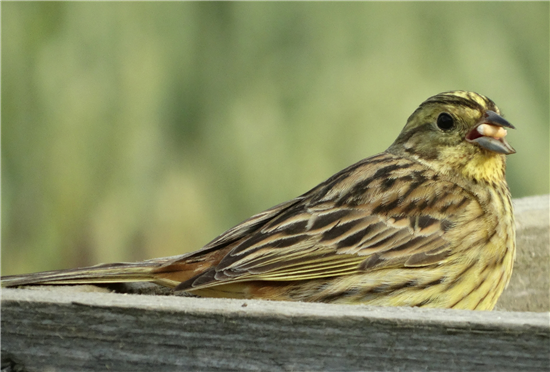 Yellowhammer female
The yellowhammer is very much a bird of farmland, preferring open arable areas with plentiful hedgerows and scrub. They nest close to or on the ground, in quiet concealed locations. Unfortunately, this makes the nest vulnerable to predation from other birds and small mammals. They are predominantly seed eaters, although during the summer months the diet, especially of young birds, will also include invertebrates such as caterpillars, spiders, beetles and worms.
Yellowhammers feature strongly in culture and folklore, perhaps unsurprisingly for a species that must have been fairly common in pre-industrial times. Several works by Beethoven were said to have been inspired by the bird’s song, including the famous opening to the Fifth Symphony. The title of Burns’ poem “The Yellow, Yellow Yorlin” is based on an old Scottish name for the bird. Weirdly for such an innocuous bird, it was associated with evil in many areas of Scotland. In the Highlands it was known as the Devil’s Bird and was said to take a drop of the devil’s blood each May Day.
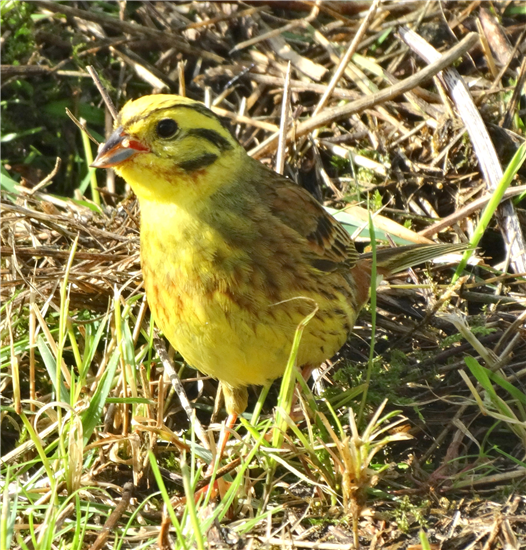 Yellowhammer male
Sadly, yellowhammer numbers have dropped alarmingly in recent decades, which may be related to changes in farming practices and a reduction in hedgerows. One particular issue seems to be the scarcity of seeds over winter, linked to fewer fields left as stubble and increased reliance on winter crops. There is some evidence that providing game cover and species-rich field margins can go some way to alleviating the problem. Despite these issues, the yellowhammer remains a relatively common sight, and sound, around the rural areas of East Lothian.
Keep up to date
Keep up to date with all things Countryside Ranger on the service’s Facebook or Instagram pages. You’ll find news and information to help you make the most of your time in our coast and countryside spaces as well as beautiful photography of the species that live here.
Facebook: @ELCrangers
Instagram: @elcrangers