A Ranger writes: native orchids
Our Countryside Rangers have a wealth of knowledge on the places, plants and species that call East Lothian home. In this issue, Ranger Richard English tells us about orchids.
The orchid family, or Orchidaceae to be technical about it, is a huge group of plants consisting of roughly 28 000 species worldwide. It’s thought to be the second largest family of flowering plants, lagging only behind the daisy family (the Asteraceae), which includes dandelions, ox-eye daisies and sunflowers. It’s hardly surprising that orchids exhibit a vast diversity of forms and can be found in almost all of the world’s ecosystems.
In the UK we have over fifty native species of orchid. These range from the relatively common to the rare and heavily protected; in addition, they also show the same weird and wonderful diversity exhibited by their international relatives. Here in East Lothian, you won’t find anywhere near this number, but we do have a healthy selection of orchids growing wild.
Many orchids have spectacularly beautiful flowers, others less so. The bird’s-nest orchid is a rather scabby looking yellowish-brown plant, easily overlooked in amongst the leaf litter of the woodland floor where it lives. The stems, flowers and seed heads all have the same drab appearance and the plant has no green bits at all. This is because this particular species has evolved to avoid photosynthesis altogether and therefore lacks chlorophyll. Instead, it gains its nutrients from fungi found in the soil, which, in turn, tap into tree roots for their energy.
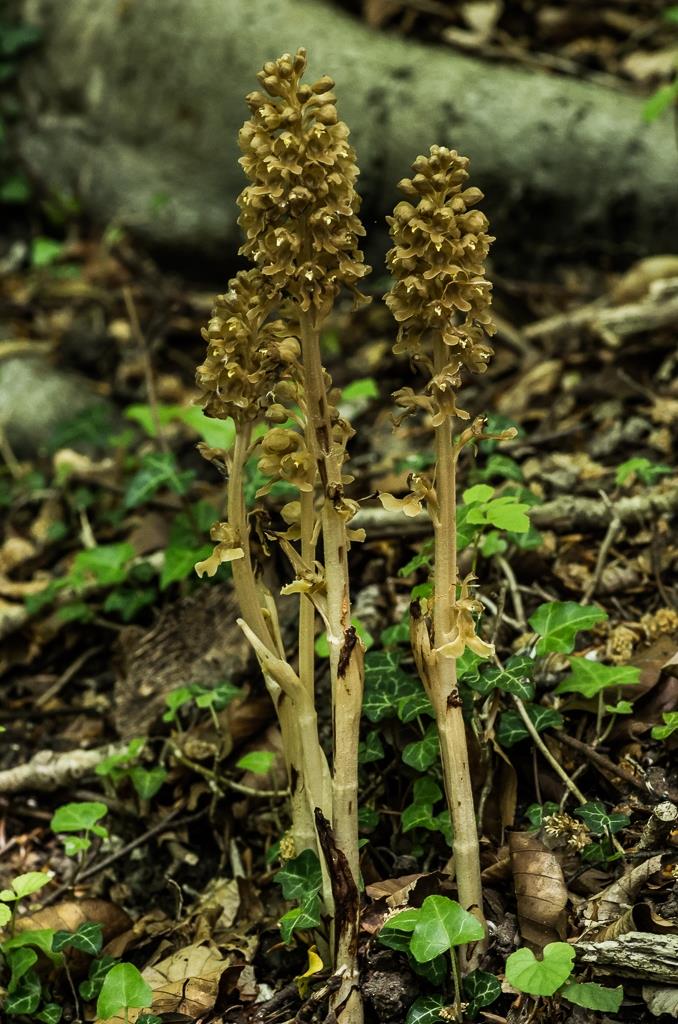 Birds nest orchid Credit: Ian Capper
The reliance of the bird’s-nest orchid on fungi is indicative of the importance of interrelationships between widely differing organisms within ecosystems. Indeed, most, if not all orchid species have a similar link to fungi at some point in their life cycles. This is termed myco-heterotrophy, if you want to get all scientific about it and occurs when a plant species derives some or all of its energy from parasitising a fungus, rather than via photosynthesis. Those, like the bird’s-nest orchid which rely entirely on this process are called full, or obligate myco-heterotrophs; other species, capable of photosynthesis but still somewhat reliant on fungi are partial, or facultative myco-heterotrophs. These relationships are not exclusive to orchids – in fact, most plants are dependent, to some extent, on complex interactions with fungi and other organisms.
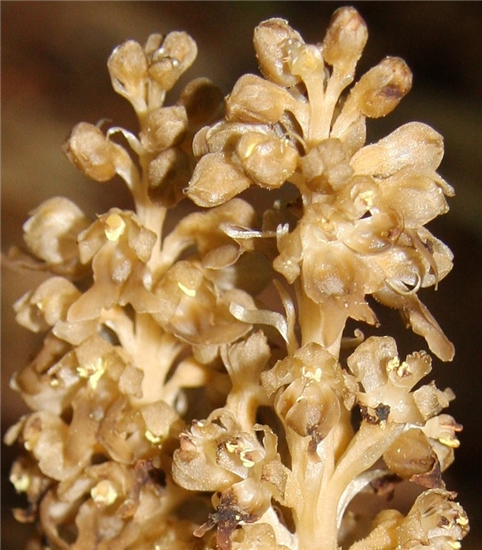 Birds nest orchid close-up
The plant derives its name from its complex tangled root system, which is said to resemble a bird’s nest, albeit a somewhat scruffy one. The scientific name, Neottia nidus-avis, comes from the same root (pun intended) – ‘nidus-avis’ being Latin for bird’s nest.
Like many orchids, this is not a common plant, although it can be found across the UK. In East Lothian there are a few plants in Butterdean woods and in woodlands near Pencaitland and Gifford. There will be others dotted around the county, but the species’ elusive nature means it’s possibly under recorded. Even where it is known, there are generally only a few plants found and, unfortunately, it’s regarded as a species under threat and in decline. This makes it all the more important that we value those few left in the county and protect their woodland habitats.
Keep up to date
Keep up to date with all things Countryside Ranger on the service’s Facebook or Instagram pages. You’ll find news and information to help you make the most of your time in our coast and countryside spaces as well as beautiful photography of the species that live here.
Facebook: @ELCrangers
Instagram: @elcrangers