A Ranger Writes - tar spots and leaf life cycles
Countryside Ranger Richard English talks tar spots and sheds new light on the difference the environment makes to a leaf's life cycle.
If you’re out and about near sycamore trees, take a look at their leaves (which may involve looking at the ground, given the time of year). You’re likely to find that they are covered in black, or very dark brown, spots. These are caused by the tar spot fungus, Rhytisma acerinum. This is a very widespread species, found throughout the UK, Ireland, northern and central Europe and North America. It affects a range of trees belonging to the genus Acer – basically maples and their relatives. This broad distribution has led to the fungus having different names in different places. Here, you might hear it referred to as sycamore tar spot, whereas in America it’s more likely to be called tar spot of maples.
Complex life cycle
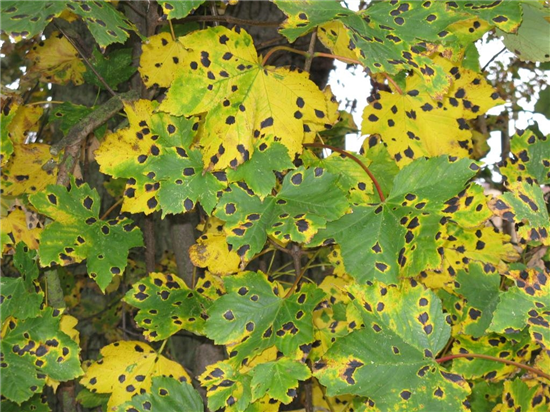 Tar spots on leaves. Photo credit M J Richardson
This fungus belongs to a group called the ascomycetes, which don’t produce the classic mushroom-type fruiting body. Instead, the spores are borne in tiny sac-like cells called asci. The tar spot has a very complex life-cycle, which is perfectly adapted to the changing seasons. The tar spot lesions start to form in spring, as spores from the previous year’s fungi colonise young sycamore leaves.
At first, these appear as pale green or yellow patches, which gradually spread. As the summer progresses, these develop into the characteristic black spots, although they often retain a yellow fringe. The darkening of the spots results from the development of fungal tissue known as mycelium, through which the fungus is able to absorb nutrients from the leaf.
During late summer, asexual spores are produced within the lesions, although the purpose of these spores in unclear, as they don’t seem to have any real function in the reproduction of the fungus. I’m sure that the fungus has very good reasons for doing this – we just haven’t sussed them out yet.
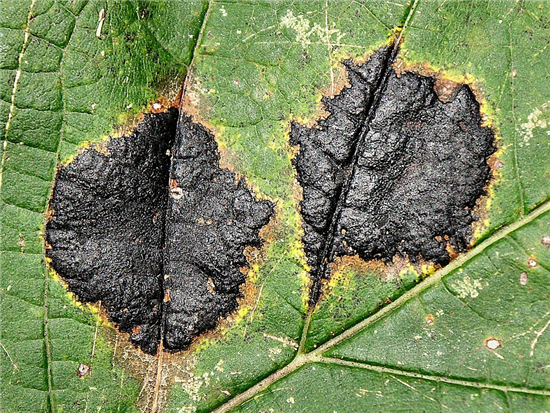 Tar spot up close. Photo credit Ian Alexander
An admission
However, it’s in the autumn and winter that the really cool stuff happens. Cup-shaped bodies, called apothecia, which contain the asci (remember them?) develop within the spots. These apothecia survive the winter on fallen leaves and it’s during this period that sexual spores develop within the asci. As things warm up in the spring, the spores are released, just when there are lots of lovely new sycamore leaves waiting for them.
Right, enough technical stuff and on to an admission. It used to be widely thought that tar spot fungus was indicative of good air quality. This was due to the fungus being rare on urban trees and also, in lab tests, being vulnerable to damage from certain pollutants common in towns, particularly sulphur dioxide. However, it now appears that the absence of tar spot in urban areas is likely due to road sweepers and diligent gardeners clearing away fallen leaves, thus interrupting the life-cycle.
I have to hold my hands up to having told people about the air quality thing in the past – I may have even written about it in these pages in previous articles. It just goes to show that even an old ranger can learn new things.
Keep up to date
Keep up to date with all things Countryside Ranger on the service’s Facebook or Instagram pages. You’ll find news and information to help you make the most of your time in our coast and countryside spaces as well as beautiful photography of the species that live here.
Facebook: @ELCrangers
Instagram: @elcrangers