Report highlights improvements to recycling services
A new report has highlighted improvements to our council's household recycling services in East Lothian in recent years and the resulting benefits.
The update report presented to Council detailed operational changes, performance successes and environmental initiatives delivered by Waste Services.
New figures showed East Lothian is a UK leader among local authorities in kerbside recycling with the collection system achieving contamination rates below five per cent.
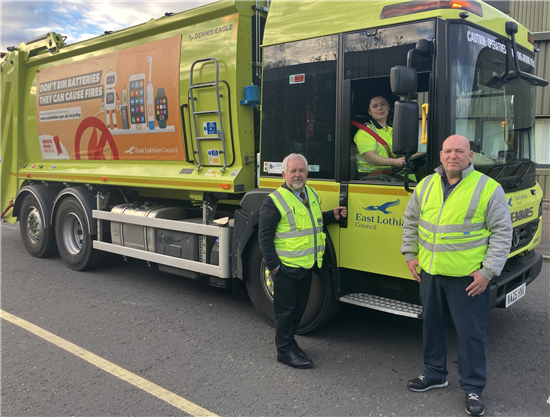 Councillor John McMillan recently visited our Kinwegar Recycling Centre and
met with Waste Services Officer Peter Moore and Recycling Adviser Helen Reilly.
Elected members heard service improvements helped the county attain the third highest recycling rate among Scotland’s 32 councils at 54.3 per cent.
The report also highlighted the contribution of residents who separate recyclable materials prior to collection, increasing their value within recycling markets as well as bolstering environmental sustainability. The disposal cost savings from good recycling practices by householders saved our council around £1.5 million in 2024.
Councillors were told recyclable materials are sold into national markets, generating around £250,000 in annual income to fund our much-needed services.
Since becoming a signatory to the Scottish Government Household Recycling Charter in 2016, our council has introduced significant changes to boost recycling and reduce waste sent for disposal. To comply with the Charter, weekly kerbside recycling collections were brought in for all households in 2021. In April 2024, three weekly residual waste collections were implemented, reducing weekly residual waste capacity from 120 litres to 80 and raising participation in recycling.
Successful recycling
Every domestic household receives 17 non-recyclable waste collections and 52 recycling collections each year, with around 24,000 households benefiting from 24 garden waste collections under the permit scheme introduced in 2024. This amounts to up to 93 collections per property annually, equating to almost 4.4 million individual collections.
In addition, the report outlined a range of our successful recycling programmes.
In 2024, 3296 tonnes of food waste was sent for treatment through anaerobic digestion, a process where organic material is broken down to produce both biogas, which is used to generate renewable energy, and digestate, a nutrient-rich by-product used as an agricultural soil conditioner.
Some 4371 tonnes of paper, card and cardboard were supplied for specialist reprocessing in the same year while 1951 tonnes of mixed cans and plastics were delivered to a Material Recovery Facility for sorting and separation.
Another 3157 tonnes of glass was supplied to a local reprocessor in 2024 where the glass was transformed into filtration media used in water treatment systems, including applications to provide access to clean and safe drinking water in developing countries.
Our recycling centres at Kinwegar, Dunbar and North Berwick record just over 500,000 visits each year while more than 9,000 bulky uplift collection appointments are offered to residents annually.